Feb 10th 2026
SAFER²: Advancing Reliability through Sensor and AI Fusion
The DLR project SAFER² (Sensor and AI Fusion for Enhanced PeRformance and Reliability) focused on integrating sensor data with advanced models to increase the safety and efficiency of complex technical systems. The project addressed various operational conditions, including standard operation, technically degraded states, and autonomous modes.
Innovative Methodologies for Data Integrity
To maximize the utility of limited hardware, the project developed data fusion and synthesis methodologies capable of extracting comprehensive information from a minimal number of sensors. A key component of this research involved AI-based methods for real-time fault and outlier detection. These tools verify the trustworthiness of sensor data as it is generated, allowing the system to identify and handle deviations through problem-specific responses.
From Theory to Practice: The AFM Demonstrator
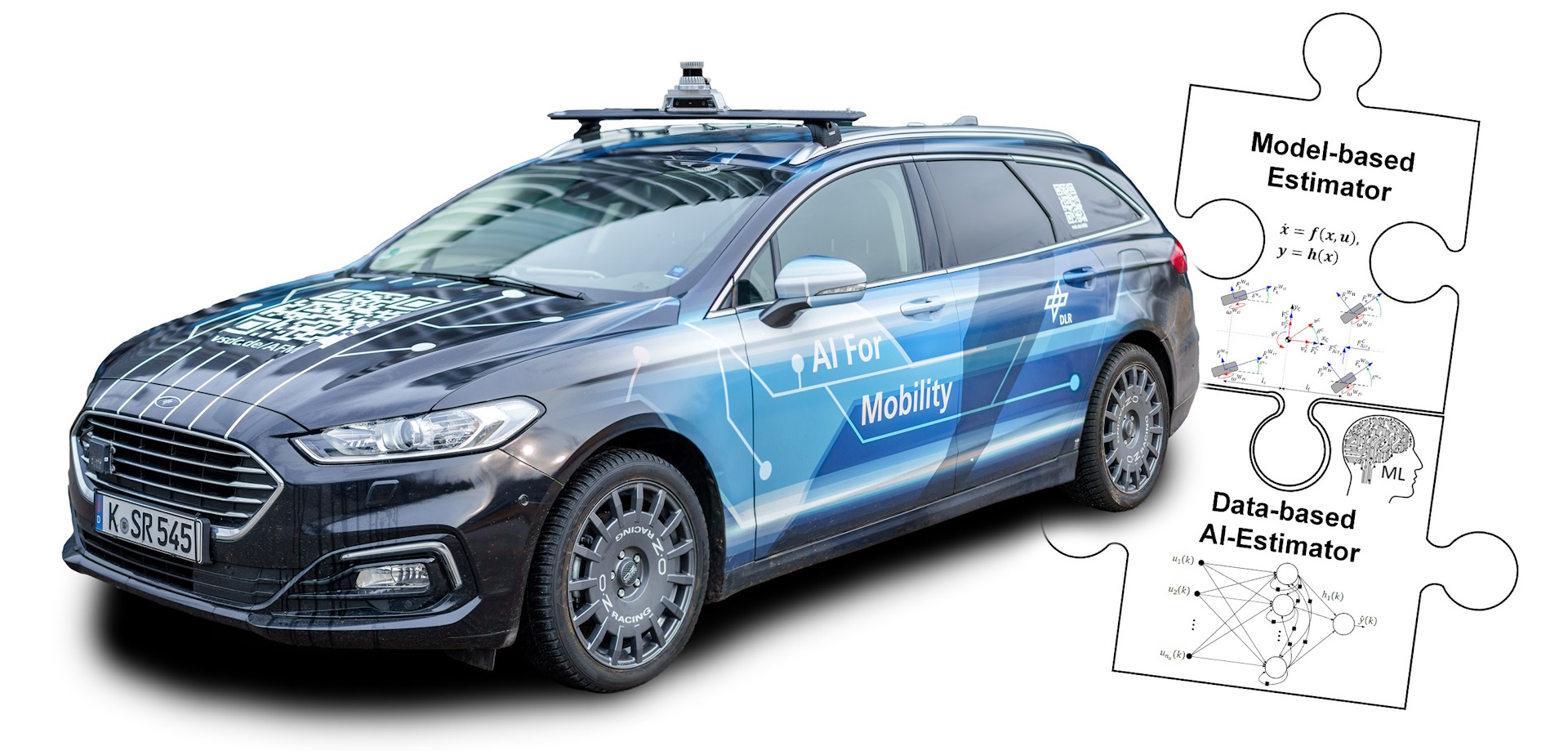
SAFER² maintained a strong practical and cross-sectoral focus, validating its methodologies across five distinct hardware demonstrators. In the field of transportation, the “AI for Mobility” (AFM) research vehicle served as a primary testbed. The AFM is a sophisticated platform equipped with Drive-by-wire technology, Perception sensors (LIDAR, cameras), Rapid control prototyping systems and cloud connectivity. A significant milestone was the successful testing of a novel Bayesian network-based approach for estimating sensor data trustworthiness on the AFM. Furthermore, as the project concluded at the end of 2025, a hybrid vehicle state estimator, which seamlessly fuses model-based and data-driven approaches, was successfully integrated.
A Foundation for the Future
The intelligent, hybrid sensor architectures developed during SAFER² provide a robust and reliable toolkit for capturing and processing data within highly dynamic traffic environments. Ultimately, these methods serve as a vital contribution to the end-to-end development of fully digitalized process chains.
Mit einem Freund teilen